



- Home
- >
- rTMS
Transform Your Mental Health with rTMS
At Parth Hospital, we offer rTMS, a non-invasive, evidence-based treatment to improve brain function when medications aren’t enough. Through targeted magnetic stimulation, rTMS restores neural balance and supports recovery in a safe clinical setting.
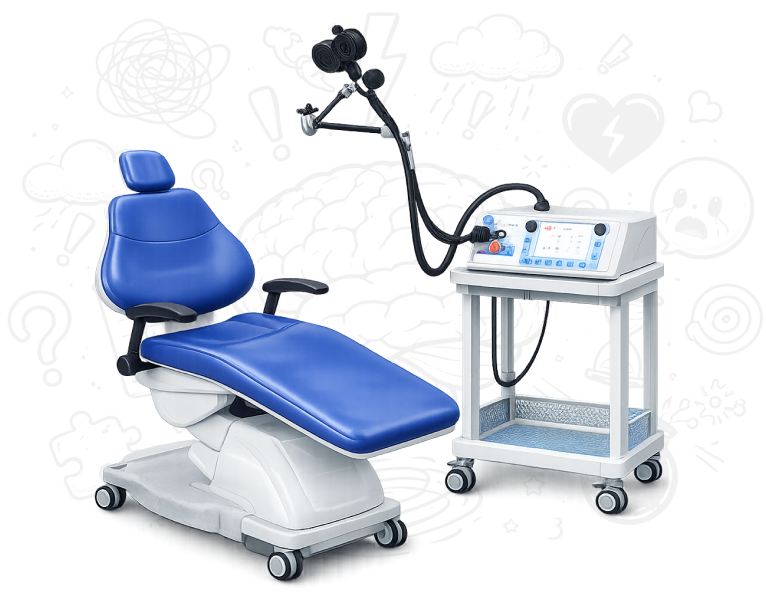
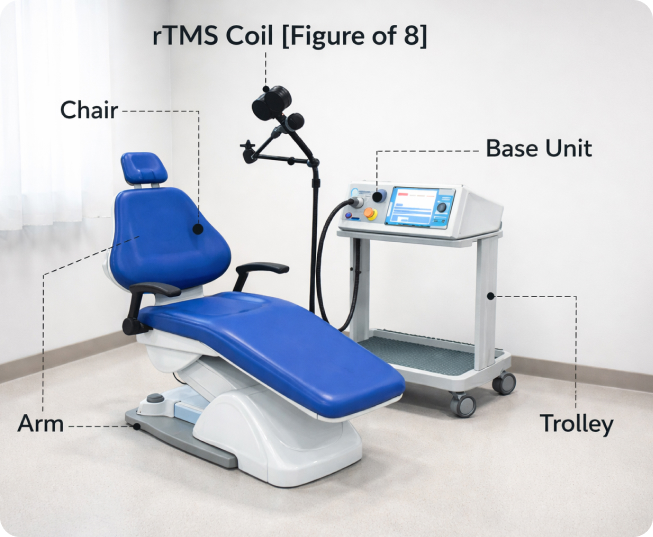
Repetitive Transcranial Magnetic Stimulation (rTMS)
rTMS stands for “repetitive transcranial magnetic stimulation.” rTMS is a non-invasive FDA-cleared medical procedure for the treatment of Major Depressive Disorder (MDD) in adults. rTMS is a brain stimulation technique that depends on the generation of brief magnetic fields using an insulated coil that is placed over the scalp.
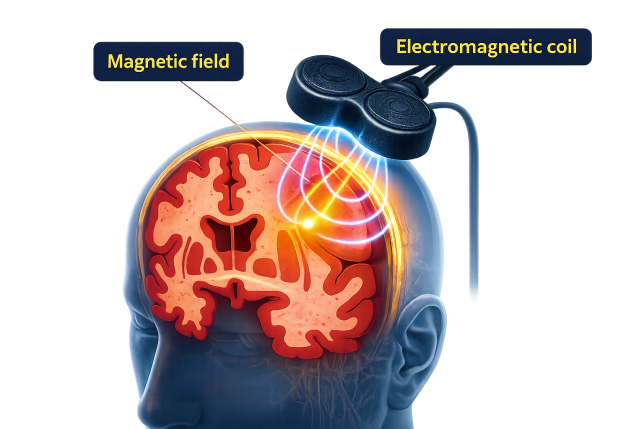
These magnetic fields are the same type and strength as those used in magnetic resonance imaging (MRI) machines. The magnetic pulses generate a weak electrical impulses in the brain that briefly activates neural circuits at the stimulation site. rTMS has been shown to be a safe and well-tolerated procedure that can be an effective treatment for adult patients with Major Depressive Disorder (MDD) who have not benefitted from antidepressant treatment.
How Does rTMS Work?
During an rTMS session, a magnetic coil is placed against your scalp near your forehead. The magnet painlessly delivers a pulse that stimulates nerve cells in the region of your brain involved in mood control and Major Depressive Disorder (MDD). It’s activates the regions of the brain that have decreased activity in Major Depressive Disorder (MDD).
What Illnesses has rTMS been Successful in Treating?
The FDA approved rTMS to treat Treatment Resistant Major Depressive Disorder (MDD) in 2007.
Since then, rTMS has been used to treat a variety of psychiatric and neurological disorders with mixed results.
rTMS seems to be particularly most effective for:
- Major Depressive Disorder,
- Auditory Hallucinations,
- Anxiety Disorders,
- Pain Disorders.
- Treatment-resistant Obsessive Compulsive Disorder
How Effective Is rTMS in Treating Major Depressive Disorder (MDD)?
rTMS is used to treat very severe cases of Major Depressive Disorder (MDD), especially those patients who do not adequately respond well to medications, or those in whom high dose medications are not usually well tolerated.
1,383 - Patients
Active rTMS vs Sham Treatment
In a study of 1,383 patients, active treatment with rTMS was concluded to be better than Sham treatment, demonstrating significant symptom improvement and higher remission rates.
47% - Responders
rTMS Added to Medication
In a pooled sample size of 230 patients, 47% patients achieved >50% reduction in symptoms when rTMS was added to the existing medication regimen, showing enhanced treatment outcomes.
Early - rTMS Matters
Active rTMS vs Sham Treatment
Also, early initiation of rTMS along with medicines seems to be more effective than just prescribing medicines alone, leading to faster symptom relief and better long-term outcomes.
2x - Higher Recovery Rate
Early rTMS + Medication
An analysis of 213 patients revealed that when rTMS is combined with medicines, early in the illness, patients are "TWICE MORE" likely to achieve complete resolution of their symptoms, than those who are just on medication alone. (Odds Ratio: 2.4 | 95% CI: 1.3–4.6)
rTMS was approved by the FDA for the treatment of Resistant Major Depressive Disorder (MDD) in 2007 and has been used extensively all over the world since.
Quick Facts About rTMS
How many sessions are required to be taken for Major Depressive Disorder (MDD)?
- For Medical Treatment Resistant Major Depressive Disorder (MDD): 40 Sessions
- For Major Depressive Disorder (MDD) Not Resistant to Medical Treatment: 20-30 Sessions
(Note: This will depend on the clinical status and response to medications)
Duration of a Session: 30 minutes approximately Two such sessions can be given simultaneously.
When can I start seeing the response to treatment?
How long do the effects last?
Accelerated TMS
What happens if symptoms re-appear post rTMS?
Can rTMS be given if the patient is already on medicine?
How is rTMS Comparable to Electroconvulsive Therapy (ECT)?
| INDICATIONS FOR rTMS | CONDITIONS REQUIRING ECT |
|---|---|
| Mild-moderate Major Depressive Disorder (MDD) Improve treatment response at early stages of illness | Melancholic Major Depressive Disorder with Psychosis Previous history of good response to ECT |
| No stigma attached No memory issues | Aggression/ Severe Irritability Complete social isolation/ poor functioning |
| Non-invasive, minimal-no side effect Safe in patients with other physical conditions such as cardiac patients, renal patients, liver damage patients | Significant feeling of hopelessness/ worthlessness Significant weight loss, refusal to eat, nutritional compromise threatening physical health |
| Treatment-resistant cases Effective when medications alone provide limited benefit | Severe slowing of actions and thoughts Residual symptoms not responding to medications |
| PREGNANCY: NO SIDE-EFFECT TO MOTHER/BABY. ABSOLUTELY SAFE | PREVENTION: SUICIDAL THOUGHT/ACTIONS/ATTEMPTS |
Is rTMS Safe for Patients?
Commonly reported experiences and side effects
techniques is its safety. Most commonly experienced:
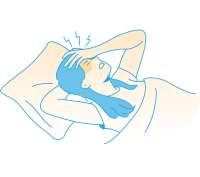
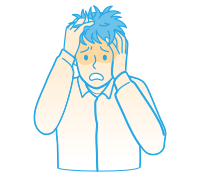
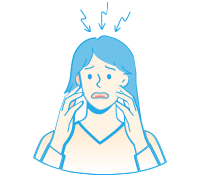
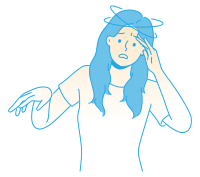
All these side effects are self-limiting. Some patients need to consume an over the counter analgesic for the resolution of headache (e.g. Ibuprofen). The most serious side effect with rTMS treatment is the possibility of a seizure occurrence. The probability of a seizure is ∼0.01% to 0.1%
| Seizure Risk | Contraindications |
|---|---|
|
rTMS 0.01% to 0.1% |
|
|
Anti-Depressant Medicines 0.1% to 0.6% | |
| |
|
Normal Population 0.07% to 0.09% (Chances of spontaneous seizure generation) |
FAQs
Are there any long-term risks associated?
Currently available data from repeated application of high intensity, time-varying magnetic fields to humans, as in magnetic resonance imaging, do not suggest that the long-term risks of rTMS are significant.
Can I take rTMS alone, if I don’t want to take medicine?
What are the results of rTMS in Schizophrenia?
Can rTMS help in recovery after a brain stroke?
What is the role of rTMS in Fibromyalgia & Pain Management?
Does rTMS have a role to play in Migraine?
Scientific References
Evidence-based research supporting our clinical approach
Slotema CW, Blom JD, Hoek HW, Sommer IE. Should we expand the toolbox of psychiatric treatment methods to include Repetitive Transcranial Magnetic Stimulation (rTMS)? A meta-analysis of the efficacy of rTMS in psychiatric disorders. J Clin Psychiatry 2010; 71:873.
Liu B, Zhang Y, Zhang L, Li L. Repetitive transcranial magnetic stimulation as an augmentative strategy for treatment-resistant Major Depressive Disorder (MDD), a meta-analysis of randomized, double-blind and sham-controlled study. BMC Psychiatry 2014; 14:342.
Berlim MT, Van den Eynde F, Daskalakis ZJ. High-frequency repetitive transcranial magnetic stimulation accelerates and enhances the clinical response to antidepressants in major Major Depressive Disorder (MDD): a meta-analysis of randomized, double-blind, and sham-controlled trials. J Clin Psychiatry 2013; 74:e122