




- Home
- >
- Deep TMS
Deep TMS: A New Hope for Mental Health
At Parth Hospital, we offer Deep TMS, an advanced, non-invasive treatment that reaches deeper brain structures for enhanced therapeutic results. Using the patented H-Coil technology, Deep TMS delivers precise magnetic stimulation to treat Major Depressive Disorder (MDD), OCD, and anxiety disorders when traditional methods fall short.
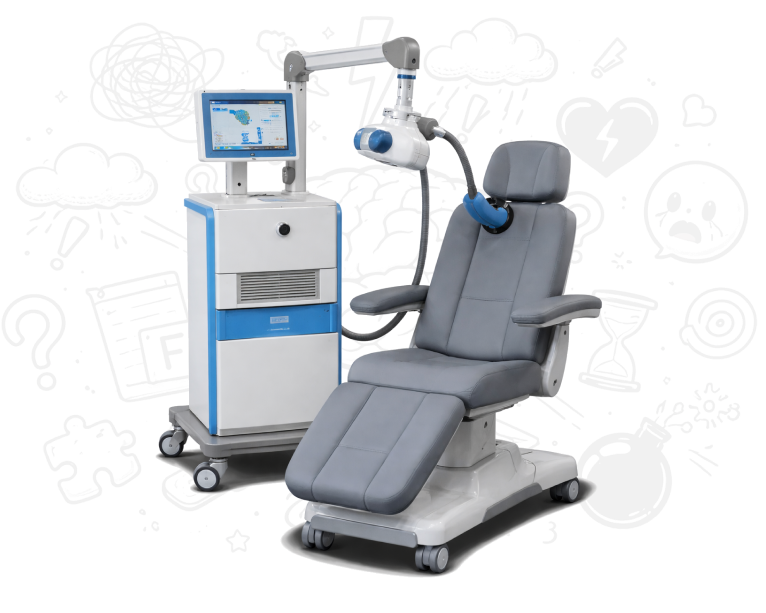
What Is It?
- Non-invasive brain stimulation using magnetic fields
- Similar to MRI technology
- 20-minute sessions in office setting
- Uses specialized H-Coil helmet
How it works?
- Targets left dorsolateral prefrontal cortex
- Generates focused magnetic pulses
- Creates small electrical currents
- Activates neurotransmitters (serotonin, norepinephrine, dopamine)
Key Benefits
- Reaches deeper brain structures
- Broader coverage of brain regions
- No decrease in magnetic field intensity
- No neuronavigation equipment needed

Treatment Applications
- FDA-approved for Major Depression and OCD
- Treats multiple mental health conditions
- Effective for treatment-resistant depression
- Helps reduce smoking addiction

Patient Experience
- Comfortable outpatient procedure
- No anesthesia required
- No hospitalization needed
- Minimal side effects
| ASPECT | DEEP TMS | CONVENTIONAL TMS |
|---|---|---|
| Coil type | H-shaped coil inside a helmet | Figure 8 coil |
| Magnetic stimulation depth | 1.25 inches | 0.27 inches |
| Session length | 20 minutes per session | 30-40 minutes per session |
| FDA treatment indications | MDD, OCD, short-term smoking cessation | MDD |
| European CE certification mark | MDD, OCD, AD, Autism, Bipolar Disorder, Chronic Pain, MS, Parkinson's Disease, post-stroke rehabilitation, PTSD, the negative symptoms of Schizophrenia, and smoking cessation | MDD, certain migraine headaches |
| Field of stimulation | Wider | More focal |
| Targeting | Direct stimulation of deeper and wider ranges of the brain | More focal |
| Effectiveness | Shown to be more effective in treating certain patients and conditions, such as OCD and moderate-to-severe Major Depressive Disorder (MDD) | Generally less effective in treating deeper brain structures and conditions requiring broader stimulation |
>33%
Treatment-Resistant Success
Over 1/3 of patients achieved >30% reduction in OCD severity
60%
Post-Marketing Study
200+ patients showed >30% reduction in severity
90%
Long-Term Success
Maintained improvement for over 1 year
38.1%
Response Rate
Active treatment vs 11.1% with sham
Treatment Details
- Targets medial prefrontal cortex and anterior cingulate cortex
- High-frequency (20 Hz) stimulation
- Daily treatments for 6 weeks
- Improvement typically seen within 20 sessions
Key Benefits
- Safety & Practicality
- Non-invasive
- No systemic or long-lasting side effects
- No recovery period needed
- Can be integrated into daily schedule
1,300+
Real-World Study Patient outcomes
80% Response rate
67% Remission (30+ sessions)
>33%
Early Remission
1/3 of patients achieved remission after just 4 weeks
>80%
Continuation Phase
Responded during continuation phase treatment
~67%
Superior to Medication
More effective than pharmacotherapy alone in ~2/3 of participants
Treatment Features
- Non-invasive
- Uses magnetic waves
- Deeper brain penetration than traditional TMS
- Targets mood regulation areas
- FDA-cleared for MDD, OCD, and smoking cessation
Quality Factors
- Well-tolerated
- High success rate
- Effective for treatment-resistant Major Depressive Disorder (MDD)
- Comparable results to 12-week pharmacotherapy but in 6 weeks
28%
Quit Rate
Active treatment quit rate
vs 11.7% with sham
4x
Under 40 Years
Higher quit rate in people under 40
7x
Higher Education
Better results with >12 years education
10yr
Shorter Smoking History
More successful with <10 years smoking history vs non-quitters
Treatment Protocol
- Daily sessions for 3 weeks
- Weekly sessions for additional 3 weeks
- Includes brief smoking provocation before treatment
- Uses H-Coil targeting bilateral insular and prefrontal cortices
Safety
- Generally well-tolerated
- Main side effect: headache during initial sessions
| ASPECT | DEEP TMS | ECT |
|---|---|---|
| Mechanism | Uses magnetic fields targeting deep brain structures via H-Coil helmet in outpatient settings | Therapeutic seizures induced by electric currents under general anesthesia (outpatient/inpatient) |
| Side Effects | Minimal; patients remain awake | Headache, muscle pain, nausea, memory loss/td> |
| FDA Status | Approved | Approved |
| Effectiveness | High success rate | Gold Standard for treatment-resistant cases |
| Treatment Setting | Can be done in clinics | Requires hospital setup |
| Cost & Access | More expensive, limited availability | More accessible, lower cost |