


A Family’s Wake-Up Call
When Mrs. Sharma’s son stopped coming out for meals and started accusing family members of stealing, she thought he was just being stubborn. Three days later, he was in crisis. “If only I had known the warning signs,” she told us at Parth Hospital.
The truth: Most psychiatric crises don’t happen overnight. Your loved one’s brain gives warning signals—like a pressure cooker whistling before it explodes.
Read more about warning signs of mental health decline →
The Crisis Warning Timeline
EARLY SIGNS (Days to Weeks)
↓ Watch closely, monitor
ESCALATING SIGNS (Hours to Days)
↓ Call doctor immediately
IMMEDIATE CRISIS (Minutes to Hours)
↓ Rush to hospital NOW
Read more about warning signs of mental health decline →
Stage 1: Early Warning Signs (थोड़ी चिंता)
| What You Notice | Why It Matters |
|---|---|
| जागना रात भर (awake all night) | Brain cannot repair itself |
| सोना 12+ घंटे (sleeping 12+ hours) | Energy system shutting down |
| दिन में सोना, रात में जागना | Body clock completely disturbed |
Understanding why depression causes fatigue and tiredness →
Other Initial Signs:
- Social withdrawal: Skipping family gatherings, avoiding relatives
- Appetite changes: Refusing favorite foods or overeating
- Personal neglect: Not bathing, wearing same clothes for days
- Increased irritability: Getting angry over small things (chai too hot, TV too loud)
- topping religious practices: Not doing puja/namaz if previously regular
Family Action: Start monitoring closely. Keep a diary with dates.
Stage 2: Escalating Signs (गंभीर चिंता)
Critical Warning Signs:
| Sign | Example | What It Means |
|---|---|---|
| शक (Suspicious thoughts) | “Everyone is watching me” | Paranoia developing |
| तेज़ बोलना (Rapid speech) | Can’t finish sentences, jumping topics | Brain racing |
| अजीब विचार (Strange beliefs) | “I have special powers” | Losing touch with reality |
| ऊर्जा में बदलाव (Energy extremes) | No sleep for 3 days OR can’t leave bed | Brain chemistry imbalance |
| बदला व्यक्तित्व (Personality change) | Aggressive person becomes withdrawn | Serious disruption |
Family Action: Contact psychiatrist IMMEDIATELY. Don’t wait for an appointment—go to hospital if needed.
Call Parth Hospital: (91) 972 420 1332
Understanding what causes depression →
Stage 3: IMMEDIATE CRISIS (तुरंत अस्पताल)
DANGER SIGNS – ACT NOW:
- Suicide talk: “मैं मर जाना चाहता हूँ” (I want to die), “Everyone better without me”
- Violence threats: Breaking objects, threatening family, holding weapons
- Hallucinations: Talking to people who aren’t there, seeing/hearing things others don’t
- Can’t care for self: Refusing food/water 24+ hours, not recognizing family
- Dangerous behavior: Reckless driving, giving away money/jewelry, wandering alone at night
Remember: During a crisis, their brain isn’t working properly—like a phone that’s completely crashed. They need medical help, not just talking.
Call 108 or rush to the nearest hospital emergency.
Parth Hospital Emergency: (+91) 972 420 1332 / (+91) 987 972 5516
Learn about hallucinations in schizophrenia →
Your Emergency Action Checklist
If IMMEDIATE Crisis (Red Flags):
- Call hospital emergency 24/7 number
- Call 108 ambulance if violent/uncontrollable
- Remove dangerous items (medicines, sharp objects)
- DO NOT leave them alone
- Take 2+ family members to hospital
If Escalating (Yellow Flags):
- Call psychiatrist TODAY—don’t wait
- Start 24-hour family watch
- Document all behavior changes with time/date
- Pack hospital bag (just in case)
- Alert all family members
Book an appointment with our psychiatrists →
If Early Signs (Green Flags):
- Keep daily mood/behavior diary
- Check medication compliance if prescribed
- Schedule psychiatrist visit within week
- Increase family time and support
- Watch for escalation to yellow/red
Understanding mental health services →
What’s Happening in Their Brain?
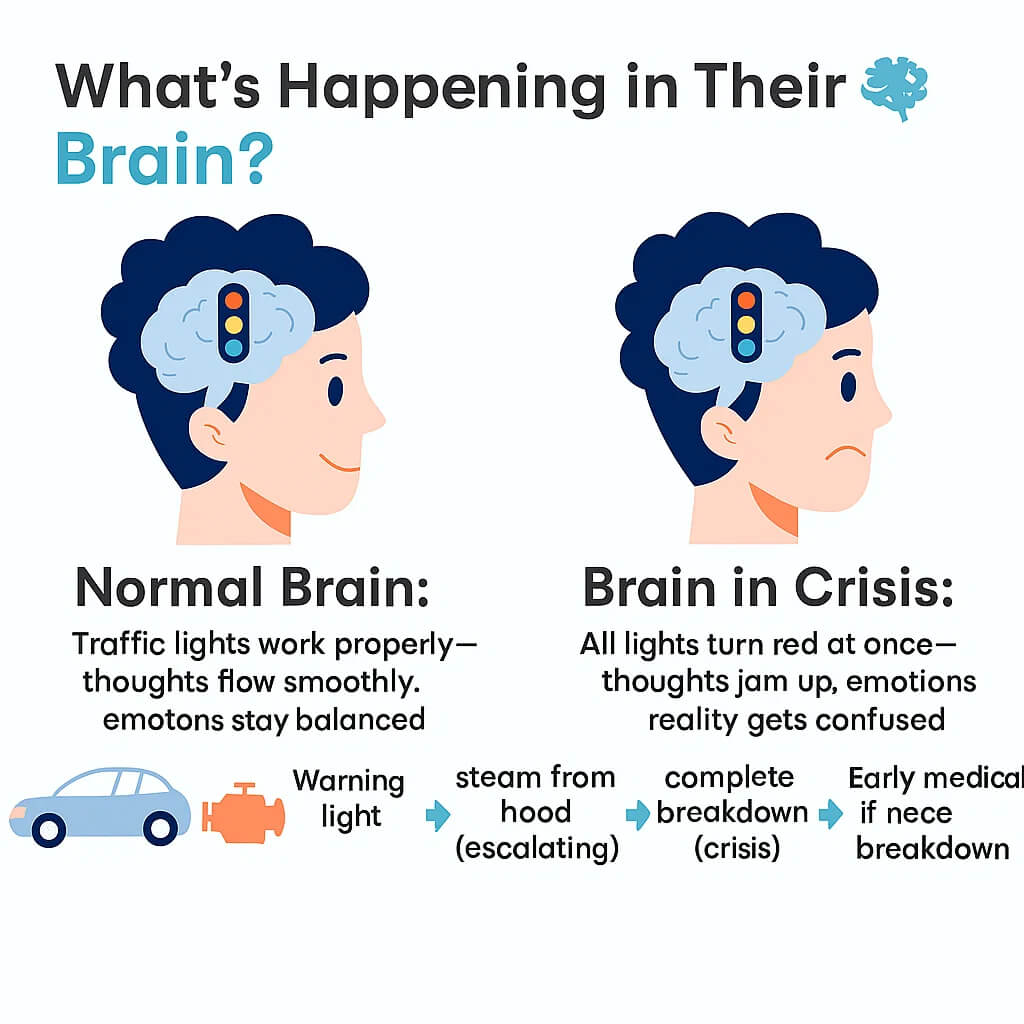
Normal Brain: Traffic lights work properly—thoughts flow smoothly, emotions stay balanced
Brain in Crisis: All lights turn red at once—thoughts jam up, emotions flood, reality gets confused
Think of it like: A car engine overheating. Warning light (early signs) → steam from hood (escalating) → complete breakdown (crisis). Early mechanic visit prevents breakdown.
Remember: This Is Medical, Not Personal
Wrong: “They’re doing this for attention”
Truth: Brain chemistry imbalance—medical emergency
Wrong: “We failed as parents/family”
Truth: Mental illness can happen in any family
Wrong: “They just need to try harder”
Truth: Can’t think your way out of brain crisis—needs medical treatment
Read: 9 Myths About Psychiatric Medication →
Understanding the role of family support →
Parth Hospital Ahmedabad
24×7 Psychiatry & Wellness Centre | Walk in anytime
Address: 3rd Floor Sigma Excellence, Near Management Enclave, Opposite Falguni Gruh Udyog, Vastrapur, Ahmedabad, 380015
24/7 Emergency Contact: (+91) 972 420 1332 | (+91) 987 972 5516
Email: info@parthhospital.com
Consultation Hours: Morning: 9:00 AM – 1:00 PM | Evening: 4:00 PM – 7:00 PM
“The best time to seek help is when you first feel worried. The second best time is now.”