


Brain Circuit Fixing: The Treatment Toolbox
Depression treatment isn’t feeling better through willpower—it’s medical restoration of brain function by various means.
Imagine fixing your house’s electrical system with the proper tools.
Understanding what’s happening in your brain is the first step to recovery.
What is clinical depression and how does it affect the brain? →
Treatment #1: Antidepressants (Chemical Repair)
How medication really works:
Without meds:
Message sent → Removed too fast → Weak signal ❌
With meds:
Message sent → Remains longer → Strong signal ✅
| Type | What It Repairs | Timeline | Common Names |
|---|---|---|---|
| SSRIs | Serotonin (mood, sleep) | 4–6 weeks | Fluoxetine, Sertraline |
| SNRIs | Serotonin + Norepinephrine (mood + energy) | 4–8 weeks | Venlafaxine, Duloxetine |
| Atypical | Multiple systems | 2–6 weeks | Bupropion, Mirtazapine |
Many people worry about psychiatric medications based on myths they’ve heard. Understanding the facts is crucial.
What is clinical depression and how does it affect the brain? →
The meds timeline:
| Week | Brain Changes | What You Notice |
|---|---|---|
| 1–2 | Reaching brain cells | Maybe better sleep, possible side effects |
| 3–4 | Chemicals stabilizing | Slight energy boost |
| 5–6 | New connections forming | Mood starts to improve |
| 7–8 | Circuits changing | Better function, motivation returns |
| 9–12 | Pathways strengthened | Improved a lot |
Priya’s experience (name changed): “Week 3—nothing. Almost quit. Week 6—laughed at a joke. Week 10—went to work without fear. Week 12—felt like myself again. Patience was worth it.“
Depression often causes extreme fatigue that makes even simple tasks feel impossible. As treatment progresses, energy levels gradually improve.
Why depression makes you extremely tired →
Learn more about Long-Acting Injectable Medications →
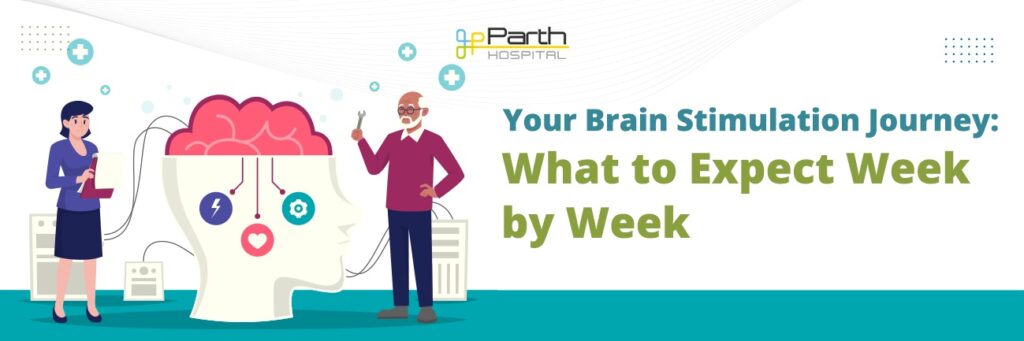
Treatment #2: Brain Stimulation (Direct Circuit Repair)
When medication is not enough, we directly repair circuits with controlled stimulation.
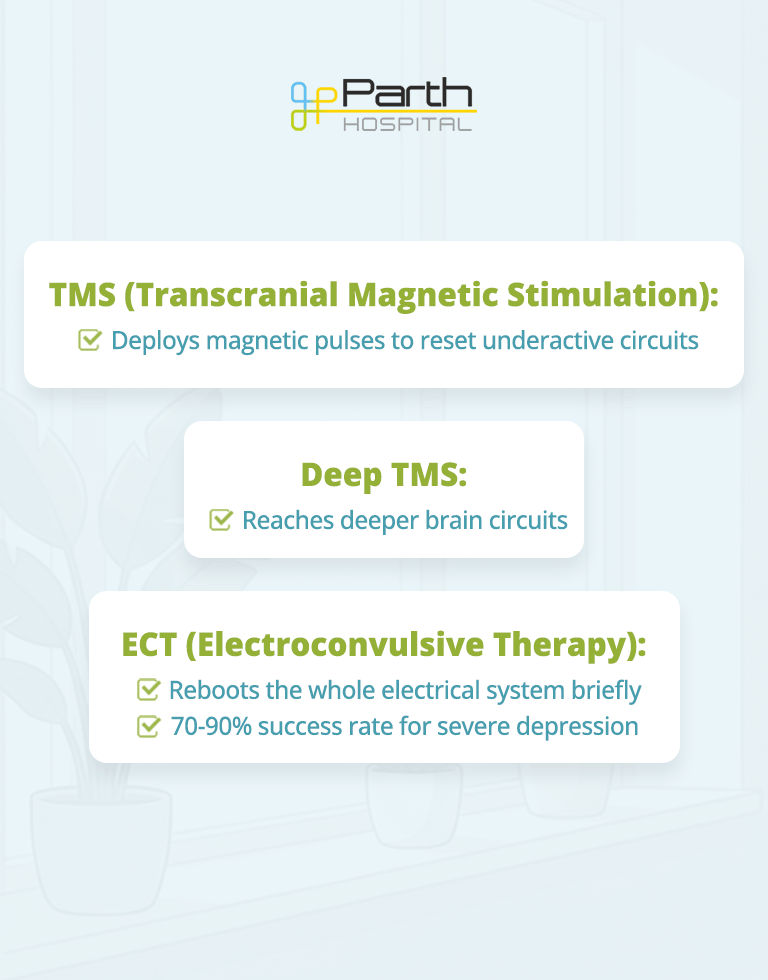
TMS (Transcranial Magnetic Stimulation):
- Deploys magnetic pulses to reset underactive circuits
- Similar to using a magnetic device to reboot isolated areas
- 20-30 sessions over 4-6 weeks
- 50-60% success rate for treatment-resistant depression
Deep TMS:
- Reaches deeper brain circuits
- Stronger than standard TMS
- Effective in severe cases
- Offered at Parth Hospital
ECT (Electroconvulsive Therapy):
- Similar to hitting reset button on stuck computer
- Reboots the whole electrical system briefly
- 70-90% success rate for severe depression
- Recent techniques are safe, involve anesthesia
Treatment #3: Ketamine (Rapid Rebuilding)
How ketamine is different:
| Method | Approach | Timeline |
|---|---|---|
| Traditional antidepressants | Gradually modulate chemicals | Weeks to months |
| Ketamine | Suddenly opens new pathways | Hours to days |
The construction analogy:
- Traditional: Gradually renovating while still living in house
- Ketamine: Construction team for speedy renovation
Best suited for: Severe, treatment-resistant depression, suicidal ideation needing quick intervention.
The Science: Neuroplasticity (Brain’s Repair Ability)
BDNF (Brain-Derived Neurotrophic Factor):
- Imagine it as “food for brain cells”
- Depression lowers BDNF
- Effective treatments raise BDNF
- More BDNF = more new connections = better function
Prior to treatment:
Negative thoughts → Strengthen depressive pathways → More negative thoughts → Hopelessness cycle
During recovery:
Treatment → New pathways form → Positive thoughts increase → Improved mood → Strengthened healthy circuits
Understanding the biological basis of depression helps reduce stigma and encourages proper treatment. What causes depression: Internal or external factors? →
Integrated Treatment: Why Combinations Work Best
Complete repair approach:
| Treatment Type | Targets | Timeline | Combine With |
|---|---|---|---|
| Medication | Brain chemistry | 4–8 weeks | Therapy + lifestyle |
| Brain stimulation | Circuits directly | 2–6 weeks | Medication + therapy |
| Therapy (CBT) | Thought patterns | 8–16 weeks | Any brain treatment |
| Lifestyle | Overall brain health | Ongoing | All treatments |
Why combinations work better:
- Addresses chemistry, circuits, thoughts, behaviors
- Creates multiple pathways to recovery
- Builds long-term resilience
Therapy plays a crucial role in rewiring thought patterns while medication stabilizes brain chemistry.
What causes depression: Internal or external factors? →
Recovery Timeline: What to Expect
Complete repair approach:
| Phase | Duration | Brain Changes | Life Changes |
|---|---|---|---|
| Crisis Stabilization | Weeks 1–4 | Chemistry normalizing | Safety restored, severe symptoms decrease |
| Circuit Repair | Weeks 4–12 | New pathways emerging | Function improving, mood stabilizing |
| System Integration | Months 3–6 | Systems integrated | Healthy patterns automatic, resilience restored |
| Maintenance | Ongoing | Brain maintains health | Continued growth, prevention |
Recognizing the early warning signs of relapse is key to maintaining long-term recovery.
Warning signs your mental health may be declining →
Success Indicators
| Brain function improvements: | Improvement in life functions: |
|---|---|
| Improved concentration and memory | Back to work/school |
| Enhanced decision-making | Relating again |
| Emotional regulation is restored | Doing things |
| Sleep and appetite normalize | Planning ahead |
| Energy and drive boost | Physical health enhances |
The Hopeful Message
Depression causes temporary, reversible changes in your brain. With treatment, your brain effectively rebuilds itself into a healthier, more resilient state.
Recovery isn’t merely going back to baseline—it’s usually becoming stronger and emotionally able than ever before.
Getting Comprehensive Treatment
| Parth Hospital Depression Program provides: | Questions to ask your doctor: |
|---|---|
| Neurological evaluation and brain mapping | What are the brain changes behind my symptoms? |
| TMS and Deep TMS | What treatments address my affected circuits? |
| ECT in severe cases | How do we track brain function improvement? |
| Ketamine therapy | What combination provides best recovery opportunity? |
| Comprehensive therapy programs | |
| Family education and support |
Learn about all our mental health services →
Parth Hospital Ahmedabad
Inpatient & Emergency Psychiatric Services
Address: 3rd Floor Sigma Excellence, Near Management Enclave, Opposite Falguni Gruh Udyog, Vastrapur, Ahmedabad, 380015
24/7 Emergency Contact: (+91) 972 420 1332, (+91) 987 972 5516
Email: info@parthhospital.com
Consultation Hours: Monday – Saturday (Morning: 9:00 AM – 1:00 PM | Evening: 4:00 PM – 7:00 PM)
🆘 In case of crisis in your loved one, call Parth Hospital Ahmedabad for urgent assessment.
The crisis is short-lived. Recovery is attainable. Support is at hand.
Medical Disclaimer: This content is for educational purposes only and does not constitute medical advice. Decisions about inpatient psychiatric care should be made in consultation with qualified mental health professionals who can assess the individual’s specific situation. Every case is unique and requires professional evaluation.
If you’re concerned about a loved one’s mental health, contact a mental health professional or crisis service immediately for proper assessment and guidance.