




When Every Morning Felt Like a Battle
Meera Shah (name changed), 26, from Mumbai, knows what it’s like when your brain feels like a phone with buggy software. Some days it worked perfectly. Some days it crashed without warning.
Her family never knew which version they’d wake up to.
“My parents’ faces every morning asking ‘beta, dawai li?'” Meera says. “The disappointment when I forgot. The fear when symptoms returned. I felt like I was letting everyone down.”
Many people don’t realise that forgetting medication isn’t about being careless—it’s often a symptom of the condition itself, affecting memory and executive function.
Understanding why depression affects concentration and memory →
The Cycle No One Talks About
Miss pills → Symptoms return → Crisis → Hospital
↑ ↓
Promises ← Brief stability ← Discharge ←┘
This wasn’t just Meera’s struggle – it was her entire family’s life for two years. The warning signs of relapse were there, but the cycle kept repeating.
Recognizing warning signs of mental health decline →
Meera’s “Before” Reality
| Life Area | The Truth |
|---|---|
| Hospitalizations | 6 admissions in 2 years |
| Career | Lost 3 jobs—couldn’t be reliable |
| Relationships | Boyfriend left—”too much uncertainty” |
| Independence | Living with parents at 26 |
| Family Stress | Daily medication battles |
| Mental Clarity | Brain fog from medication ups and downs |
“I was a marketing graduate with dreams,” she says. “But I couldn’t even remember my own medication. How could I handle a career?”
Her mother remembers: “Every morning was a prayer. Will we rush her to hospital again? We weren’t living—we were surviving.”
The family’s experience mirrors what many caregivers go through—the constant vigilance and emotional exhaustion.
The Turning Point: Monthly Injections
When Dr. Parth at Parth Hospital suggested monthly long-acting injections (LAIs), Meera had the doubts you might be thinking:
- “Will injections hurt?”
- “Will it be embarrassing?”
- “What if coworkers find out?”
- “Is this just another thing that won’t work?”
But she was ready for change.
Long-acting injectable medications have transformed treatment adherence for many patients with mental health conditions.
Learn more about Long-Acting Injectable Antipsychotics →
Many of Meera’s concerns were based on common misconceptions about psychiatric medication.
Read: 9 myths about psychiatric medication debunked →
Meera’s Transformation Timeline
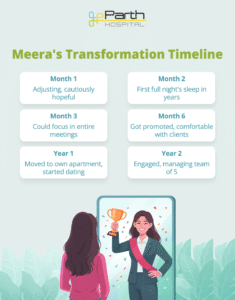
| Time | Real Progress |
|---|---|
| Month 1 | Adjusting, cautiously hopeful |
| Month 2 | First full night’s sleep in years |
| Month 3 | Could focus in entire meetings |
| Month 6 | Got promoted, comfortable with clients |
| Year 1 | Moved to own apartment, started dating |
| Year 2 | Engaged, managing team of 5 |
“Month 2 was when I knew something was different,” Meera says. “I slept through the night for the first time in years. No midnight anxiety about morning pills.”
The restoration of normal sleep patterns is often one of the first signs that treatment is working effectively.
Why LAIs Work Better: The Simple Science
Daily Pills = Medication Rollercoaster
- Morning: High dose flood
- Afternoon: Dropping
- Evening: Running low
- Night: Brain struggling
LAI Injections = Steady Supply
- Consistent medication levels all day, every day
- Your brain gets what it needs, when it needs it
“My brain finally had a chance to heal properly,” Meera explains. “No more roller coaster.”
This stability allows the brain to undergo the healing process called neuroplasticity—the brain’s ability to form new, healthier connections.
Understanding mental health treatment and brain healing →
Life Today: The Complete Picture
| Aspect | Before LAIs | After LAIs |
|---|---|---|
| Career | Job insecurity | Senior Marketing Manager |
| Relationships | Isolated, single | Engaged, independent |
| Daily Life | Unpredictable moods | Consistent energy, clear thinking |
| Future Plans | Couldn’t plan beyond next week | Planning wedding + MBA |
The Reality: What One Injection Does
15-minute monthly appointment gives you 30 days free from:
- Daily medication reminders
- Pill-taking stress
- Missing doses
- Family medication battles
- Medication level fluctuations
“My colleagues don’t know my diagnosis,” Meera says. “They just know I’m reliable, focused, good at my job. The injection is private. My success is public.”
Understanding LAI Treatment
LAIs are particularly helpful for certain psychiatric conditions including:
Schizophrenia and psychotic disorders – Where medication consistency is crucial for preventing hallucinations and delusions
Understanding hallucinations in mental illness →
Bipolar disorder – Where mood stability depends on consistent medication levels
Treatment-resistant conditions – When daily medications haven’t provided adequate stability
Comprehensive Treatment Approach
While LAIs provided the medication stability Meera needed, her complete recovery also involved:
- Regular psychiatric follow-ups with her treatment team
- Therapy sessions to develop coping skills and address underlying issues
- Lifestyle modifications including sleep hygiene and stress management
- Family education to create a supportive home environment
Explore Psychotherapy & Counselling services →
For some patients with treatment-resistant conditions, additional interventions may be helpful:
Learn about advanced treatments like rTMS →
Deep TMS for complex cases →
Meera’s Message
“If you’re reading this feeling hopeless—I understand. I was there. Six hospitalizations, three lost jobs, a broken relationship.
But here’s what I learned: Your diagnosis isn’t your destiny.
LAIs didn’t just give me medication—they gave me my life back. I can plan vacations, accept promotions, and dream about an MBA. My family sees me as Meera the professional, the fiancée – not just Meera the patient.”
Important Context
While LAIs have helped many patients like Meera improve medication adherence and stability, individual results vary. LAIs work best as part of comprehensive treatment including therapy, lifestyle management, and regular medical follow-up.
Like all medications, LAIs have potential side effects that should be discussed with your psychiatrist. Not everyone experiences the same dramatic improvement, and LAIs aren’t appropriate for all patients or all conditions.
Each person’s mental health journey is unique and requires personalized medical assessment and treatment planning.
🏥 Parth Hospital Ahmedabad
Long-Acting Injectable Medication Program
📍 Address: 3rd Floor Sigma Excellence, Near Management Enclave, Opposite Falguni Gruh Udyog, Vastrapur, Ahmedabad, 380015
📞 Contact:
- (+91) 6354353338
📧 Email: info@parthhospital.com
🕐 Consultation Hours:
Monday – Saturday
Morning: 9:00 AM – 1:00 PM
Evening: 4:00 PM – 7:00 PM
🌐 Website: parthhospital.com
“Success stories start with someone willing to try something new.”
📚 Resources & Information
Understanding Medication Treatment: