




Introduction: The Hidden Epidemic of Missed Bipolar Diagnoses
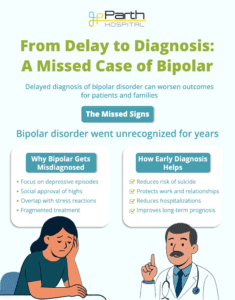
Every day at Parth Hospital Ahmedabad, families arrive burdened with years of confusion and misinterpretation. Often they share, “We thought it was just stress,” or “The mood swings were part of their personality.” This common misperception—fueled by bipolar disorder’s complex and variable presentation—delays diagnosis, leaving patients like Rina caught in a debilitating cycle for nearly a decade. This delay is more than a clinical oversight—it shapes life trajectories, fracturing relationships, derailing careers, and increasing suicide risk. Understanding why bipolar disorder is frequently missed, and how early recognition can alter outcomes, is crucial.
The Subtle Dance of Symptoms: Why Bipolar Disorder is So Elusive
Bipolar disorder wears many masks. What separates it from “ordinary moodiness” or unipolar depression is a nuanced interplay between neurobiology and lived experience—yet these nuances are easily missed.
Missed Manic and Hypomanic Episodes: The Invisible Half
Scientific studies reveal the core reason bipolar disorder is often overlooked: mania and hypomania are poorly recognized or recalled by both patients and clinicians. The DSM criteria requiring symptoms for four or more days sometimes miss briefer hypomanic episodes that still profoundly affect brain circuitry and daily functioning. These episodes can be covert—presenting as bursts of creativity, elevated productivity, or social exuberance rather than obvious mania—leading families and providers alike to mistake them for personality quirks or “energy spikes.”
Social Approval Bias: The Double-Edged Sword
Neuropsychological research shows that the manic brain activity linked with dopamine surge can manifest as heightened confidence, faster thinking, and engaging social behavior. While these can be assets superficially, they mask underlying neural dysregulation in reward and impulse circuits (primarily dopaminergic pathways in the prefrontal cortex and basal ganglia). This social approval paradox contributes to delayed recognition, as highs are celebrated, not recognized medically.
Overlapping Symptoms and Comorbidities
The biological basis of bipolar disorder involves dysfunction in multiple brain systems—mood centers, cognitive control networks, and sleep regulation circuits—creating an illness that presents heterogeneously across patients. This neurological kaleidoscope overlaps with symptoms seen in major depression, anxiety disorders, borderline personality disorder, and even schizophrenia-spectrum illnesses due to shared brain region involvement (e.g., prefrontal-limbic circuits). This symptom overlap complicates diagnosis, especially when comorbid conditions blur clinical clarity and complicate patients’ presentations.
The Neuroscience of Bipolar Disorder: A Circuit-Based Perspective
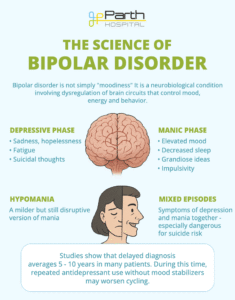
Emerging connectome-based research frames bipolar disorder not as discrete mood episodes but as dynamic shifts in brain network stability. The critical circuits implicated involve:
- Prefrontal Cortex Dysregulation: Impaired top-down control leads to poor regulation over limbic-driven emotions, resulting in mood fluctuations.
- Enhanced Striatal Dopaminergic Sensitivity: Drives reward-seeking behavior and mania/hypomania features.
- Abnormal Thalamocortical Rhythms: Disrupt sleep architecture and cognitive function during both manic and depressive episodes.
This circuit perspective helps explain why early mood stabilizers which work on neurotransmitter systems (e.g., lithium’s effect on intracellular signaling cascades and mitochondrial function) can restore network stability and prevent illness progression.
Why Early Diagnosis is a Neuroprotective Imperative
Longitudinal neuroimaging studies reveal that delayed diagnosis and inappropriate antidepressant monotherapy worsen brain network instability, accelerate neuroprogression, and increase suicide risk. Early intervention halts these pathological shifts by stabilizing circuits and enhancing neuroplasticity, allowing patients to maintain cognitive function, social relationships, and occupational engagement.
The Integral Role of Family: Beyond Clinical Observation
Families provide essential, real-world data invisible in clinical visits. They often detect subtle shifts—shortened sleep with heightened energy, increased risk-taking, or cognitive disorganization—before professionals do. Neurobehavioral studies demonstrate that monitoring circadian and activity rhythms through wearable devices combined with family reports can predict relapse better than symptom scales alone. Parth Hospital trains families in recognizing these signals, embedding psychoeducation as a therapeutic vector itself.
Rina’s Awakening: A Case Study in Neurobehavioral Recognition
Rina’s journey exemplifies classic missed bipolar disorder—years cycling through depressive treatment with transient relief, unrecognized hypomanic phases dismissed as personality traits, and devastating consequences of inadequate treatment. Only at crisis, when neural circuitry destabilized profoundly (attempted suicide and impulsive job resignation), did a detailed neuropsychiatric evaluation at Parth Hospital uncover the full illness pattern.
The integration of clinical interviews, neuropsychological assessments, and collateral family data revealed a classic bipolar spectrum disorder—leading to a tailored regimen of mood stabilizers, targeted psychotherapy, and family support, scientific pillars that recalibrated her brain’s functional networks.
Closing Thoughts
Bipolar disorder defies simplistic classification. Its nuanced neurocircuitry underlies a spectrum of mood states, often masked by societal and clinical misunderstanding. The neuroscience of early detection teaches us that careful, longitudinal assessment combined with family involvement and biomarker integration holds the key to changing life courses before irrevocable damage occurs.
At Parth Hospital Ahmedabad, this ethos transforms lives daily. Because recognizing bipolar disorder early is not just a diagnostic victory—it is the foundation for restoring hope, rebuilding futures, and rewiring brains toward stability.
If mood swings or unusual energy patterns emerge in a loved one, do not dismiss them as quirks or stress. Early evaluation can save years of suffering and alter the brain’s trajectory toward wellness.