


Introduction
Many people assume that psychiatry relies only on conversations and observation. While listening and talking remain central, modern psychiatry increasingly integrates blood tests, brain scans, and other investigations. At Parth Hospital Ahmedabad, we use these tools not to “find depression in the blood” but to rule out medical causes, improve accuracy, and ensure safe treatment. Understanding why these tests are done reassures patients and families that psychiatric care is as evidence-based and scientific as any other branch of medicine.
Why Investigations Are Needed
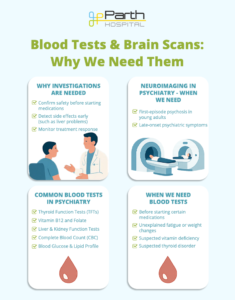
Psychiatric symptoms can sometimes be mimics of physical illness. Fatigue and sadness might be caused by thyroid disease. Hallucinations could stem from seizures. Anxiety might be linked to vitamin deficiencies. Without investigations, such conditions may be misdiagnosed as psychiatric.
Investigations also help us:
- Confirm safety before starting medications.
- Detect side effects early, like liver or kidney stress.
- Tailor treatment to individual biology.
- Rule out substance-related causes of symptoms.
Thus, tests are not an optional extra but a core component of safe psychiatric care.
Common Blood Tests in Psychiatry
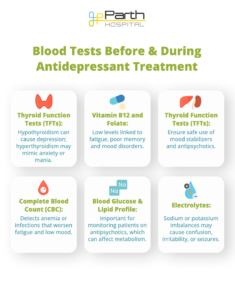
- Thyroid Function Tests (TFTs): Hypothyroidism can cause depression; hyperthyroidism may mimic anxiety or mania.
- Vitamin B12 and Folate: Low levels linked to fatigue, poor memory, and mood disorders.
- Liver & Kidney Function Tests: Ensure safe use of mood stabilizers and antipsychotics.
- Complete Blood Count (CBC): Detects anemia or infections that worsen fatigue and low mood.
- Blood Glucose & Lipid Profile: Important for monitoring patients on antipsychotics, which can affect metabolism.
- Electrolytes: Sodium or potassium imbalances may cause confusion, irritability, or seizures.
These tests give us a baseline map of physical health, guiding safe prescriptions.
Neuroimaging in Psychiatry
Scans like MRI (Magnetic Resonance Imaging) or CT (Computed Tomography) are not routine for every patient but are used selectively.
| When We Order Scans | Purpose |
|---|---|
| First-episode psychosis in young adults | Rule out brain tumors, infections, or structural lesions. |
| Late-onset psychiatric symptoms (>40 years) | Detect strokes, dementia, or neurological disease. |
| Seizure-like events or catatonia | Exclude epilepsy or brain injury. |
| Sudden personality change | Rule out space-occupying lesions. |
| Treatment-resistant illness | Rule out structural or organic contributions. |
In these contexts, imaging can transform management from psychiatric to neurological, ensuring the patient receives the right specialist care.
Electroencephalogram (EEG) and Beyond
An EEG records brain electrical activity, useful when seizures or certain rare psychiatric syndromes are suspected. For example, temporal lobe epilepsy can mimic psychosis. Sleep studies, hormone panels, and genetic testing are also occasionally used in specialized cases.
Case Illustration
A 45-year-old woman came to us with severe anxiety and panic attacks. Her family assumed it was “just stress.” A basic blood test revealed undiagnosed hyperthyroidism. With endocrinology treatment, her anxiety resolved without long-term psychiatric medication. This case reminds us that tests prevent misdiagnosis and ensure patients are not treated for the wrong illness.
Balancing Tests with Compassion
At Parth Hospital, we ensure patients never feel reduced to “lab reports.” Tests are explained in simple language, and decisions are made collaboratively. We emphasize that these investigations are not to prove someone is “mad” or “normal,” but to provide comprehensive, safe, and holistic care.
Conclusion
Blood tests and scans may seem unusual in psychiatry, but they are essential to accurate, safe, and holistic treatment. At Parth Hospital Ahmedabad, we integrate these investigations not to replace careful listening but to enhance it. For families, these tests offer reassurance: psychiatry is not guesswork, but a precise, evidence-based science.
The message is simple: your mental health deserves the same thoroughness and safety checks as your physical health—and we are committed to providing both.