



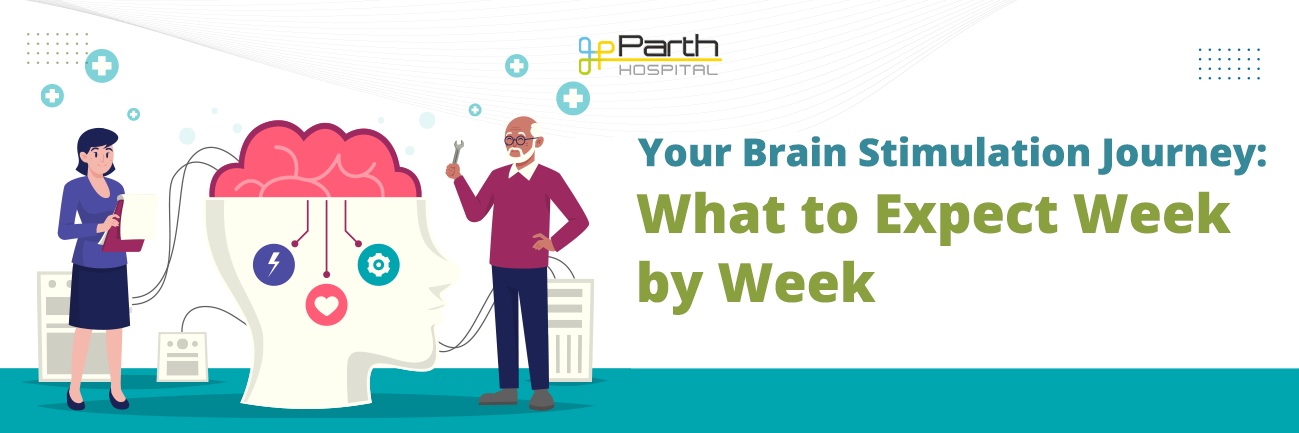
Maya’s Question: “What Exactly Happens?”
Maya gazed at the appointment card. With months of antidepressants causing unbearable side effects, her psychiatrist suggested rTMS at Parth Hospital Ahmedabad.
“What actually goes on?” she asked her husband. “It’s like driving into the unknown without a map.“
Three months later: “It was like having the most specific GPS leading us through each turn. We knew precisely where we were, what was around the corner, and when we’d arrive.”
If you’re beginning this journey – here’s your full map.
📋 Stage 1: The Assessment (Week 1)
Maya’s assessment day at Parth Hospital:
| Time | What Occurred | Purpose |
|---|---|---|
| 9:00 AM | In-depth interview of depression journey | Understanding where we are at present |
| 10:00 AM | Cognitive testing (memory, focus) | Baseline measurements |
| 11:00 AM | Medical check-up | Safety screening |
| 12:00 PM | Follow-up on previous meds/therapies | What’s already been attempted |
| 1:00 PM | Talk with husband regarding family objectives | Support network planning |
What the team establishes:
- 📊 Symptom severity (depression rating scales)
- 💼 Impact on daily life (work, family, self-care)
- 💊 Past treatment responses
- 🩺 Medical safety concerns
- 🎯 Individual treatment goals and timeline
🎯 Stage 2: Individualized Treatment Plan (Week 1)
Maya’s profile:
- Age: 34, working professional from Ahmedabad
- Condition: Treatment-resistant depression
- Previous: 4 antidepressants with side effects
- Lifestyle: Cannot take time off work for anesthesia
- Family: Two young kids at home
Recommendation: rTMS (able to work full-time during treatment)
Treatment comparison:
| Patient Type | Treatment | Why |
|---|---|---|
| Severe suicidal depression | ECT | Fastest, most effective |
| Working professional | rTMS | No anesthesia, back to work same day |
| Treatment-resistant OCD | Deep TMS | Targets deeper brain networks |
| Pregnant with serious depression | ECT | Safest during pregnancy |
Maya’s individualized plan:
- 🕚 11 AM daily rTMS sessions (between work meetings)
- 📅 6 weeks, 30 sessions total
- 🎯 Target: Left prefrontal cortex
- 📊 Monitoring: Weekly depression ratings
🔧 Stage 3: Preparation Week
Monday—Medical clearance:
- Blood tests, cardiac assessment
- Review of medications
Tuesday—Brain mapping:
- Identifying best spot to stimulate
- Practice session to check tolerance
Wednesday—Family education:
- Husband trained what to anticipate
- Childcare coordination around treatment hours
Thursday—Logistics:
- Parking arrangements
- Insurance confirmation (₹8,000-12,000 per session average)
- Emergency contacts set
Friday—Final questions:
- Treatment team meeting
- Confirmation of schedule
⚡ Stage 4: Daily Treatment Routine
Maya’s typical rTMS day:
| Time | Activity | Duration |
|---|---|---|
| 10:45 AM | Arrival, vital signs check | 5 min |
| 11:00 AM | Treatment prep (coil placement, ear protection) | 5 min |
| 11:05 AM | rTMS session (gentle tapping sensation) | 37 min |
| 11:42 AM | Quick check, next appointment confirmed | 3 min |
| 12:00 PM | Return to office work | — |
What it feels like: “Like gentle tapping on my scalp. I listened to my favorite podcast during treatment. No drowsiness, drove myself, colleagues had no idea.”
For ECT patients (different process):
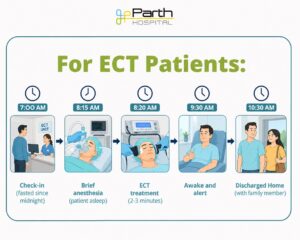
| Time | Activity |
|---|---|
| 7:00 AM | Check-in (fasted since midnight) |
| 8:15 AM | Brief anesthesia (patient asleep) |
| 8:20 AM | ECT treatment (2-3 minutes) |
| 9:30 AM | Awake and alert |
| 10:30 AM | Released home with family |
📈 Stage 5: Progress Monitoring
Maya’s week-by-week improvement:
| Week | Depression Score | Daily Function | Side Effects | Maya’s Notes |
|---|---|---|---|---|
| Baseline | 18 (severe) | 3/10 | — | “Barely getting through days” |
| Week 1 | 16 | 4/10 | Mild headache | “Sleep slightly better” |
| Week 2 | 14 | 5/10 | Scalp tenderness | “More energy in mornings” |
| Week 3 | 11 | 6/10 | Minimal | “Laughed at coworker’s joke” |
| Week 4 | 8 | 7/10 | None | “Planning weekend activities” |
| Week 5 | 6 | 8/10 | None | “Feel like myself again” |
| Week 6 | 4 (normal) | 9/10 | None | “Looking forward to future” |
Week 4 adjustment: “My progress plateaued, so Dr. Patel increased intensity by 10%. Within three days, improvement continued.”
🔄 Stage 6: Maintenance Plan (Month 2+)
End of treatment assessment:
- Depression score: 18 → 4 (normal range)
- Functioning: Returned to full work and family activities
- Quality of life: “Better than before depression started”
- Side effects: None lingering
Maintenance options:
| Type | Best For | Schedule |
|---|---|---|
| No maintenance | Complete responders | As-needed monitoring |
| Medication optimization | Partial responders | Monthly psychiatrist visits |
| Maintenance rTMS | Relapse-prone | Monthly booster sessions |
| Therapy integration | All patients | Weekly/monthly sessions |
Follow-up system:
- 📞 Month 1: Weekly phone check-ins
- 📊 Months 2-3: Bi-weekly assessments
- 🩺 Months 4-6: Monthly visits
- ✅ Month 6+: Quarterly wellness checks
💡 Maya’s Advice to Others
“The GPS metaphor is perfect. Each step was outlined ahead of time. Each worry was addressed immediately. When progress stalled, they adjusted the route. The unknown became completely predictable.“
One year later: “I haven’t needed treatment since. But if depression returns, I know exactly where to go and what to expect. That confidence alone reduces my anxiety.”
🚀 Your Journey Starts Here
Brain stimulation treatment isn’t a black-box process—it’s a well-charted path with clear milestones, expert guidance, and predictable outcomes.
What you bring:
- 📋 Medical history and medication records
- 💳 Insurance card
- 📅 Commitment to schedule
- 👨👩👧👦 Support person for initial visit
- 💪 Open mind about possibilities
What we provide:
- 🗺️ Clear map from start to finish
- 👨⚕️ Expert guidance at every turn
- 📊 Continuous monitoring and adjustment
- ❤️ Support for your family
📞 Starting your journey? Call Parth Hospital Ahmedabad for brain stimulation assessment.
Where each treatment journey is carefully planned and successfully completed. 💙