


Why “Just Cheer Up” Doesn’t Work
When a person fractures their leg, we don’t instruct them to “just walk it off.” Depression is the same—it’s a medical condition in which your brain’s electrical and chemical systems misfire in precise, quantifiable ways.
The important distinction: Depression isn’t about sadness. It’s about your brain circuits short-circuiting.
Many people confuse temporary sadness with clinical depression, but they’re fundamentally different conditions.
Understanding what clinical depression actually means →Your Brain: Similar to Your Home’s Electrical System
Normal Function:Control Center (Prefrontal Cortex) →Emotional Regulation (Limbic System) →Reward Circuits (Dopamine) →Memory Storage (Hippocampus)Outcome: Emotions in balance, motivation intact, decisions clear.Depression (Circuits Malfunction):Control Center: 30-50% less power ⚠️Emotional System: Permanently stuck on “threat mode” 🚨Reward Circuit: Barely working ⬇️Memory: Shrinking due to stress 📉Result: Everything falls apart. Understanding the biological basis of depression helps explain why it’s not just “in your head” or something you can control through willpower alone. What causes depression: Internal or external factors? →
Four Brain Areas Damaged by Depression
| Brain Area | Normal Function | In Depression | Actual Effect |
|---|---|---|---|
| Prefrontal Cortex (Decision-maker) | Makes plans, solves problems | 30–40% less activity | Simple decisions impossible |
| Amygdala (Alarm system) | Recognizes actual threats | Hyperactive—perceives danger everywhere | Almost constant anxiety, panic at small events |
| Hippocampus (Memory storage) | Stores memories, learns | Physically smaller by 10–20% | Unreliable memory, learning hard |
| Reward Center (Motivation) | Builds pleasure, drives goals | Severely lowered activity | Nothing is enjoyable (anhedonia) |
Rahul’s experience (name changed): “I couldn’t choose what to have for breakfast. People accused me of being lazy. But my decision circuit had shorted out—I was in need of repair, not reproach.”
The brain’s alarm system often goes into overdrive in both depression and anxiety—which is why many people experience both conditions together.” Understanding anxiety disorders and their connection to depression →
Depression vs. Normal Sadness: The Critical Difference
| Aspect | Normal Sadness | Clinical Depression |
|---|---|---|
| Trigger | Specific event | Often no obvious trigger |
| Duration | Days to weeks | Months (or more) |
| Brain changes | Temporary reaction | Measurable structural changes |
| Daily function | Still able to get basics done | Severely compromised |
| Physical symptoms | Crying, exhaustion | Sleep disturbance, pain, changes in appetite |
| Recovery | Time + support adequate | Needs professional therapy |
| Brain scans | Normal | Visible circuit malfunction |
The weather analogy:
- Normal sadness: Rainstorm moves on by itself
- Depression: Weather system gets stuck for months, unable to clear on its own
One of the most misunderstood aspects of depression is the extreme, persistent exhaustion it causes—this isn’t laziness, it’s a symptom of malfunctioning brain circuits. Why depression makes you extremely tired and fatigued →
The Chemical Story: What’s Actually Broken
Normal Brain:Neurotransmitter → Crosses gap → Activates cell →Good recycling → STRONG signal ✅Depressed Brain:Neurotransmitter → Crosses gap → Taken away too fast →Bad recycling → WEAK signal ❌Three important chemicals impacted:
| Chemical | Normal Function | In Depression | Outcome |
|---|---|---|---|
| Serotonin | Mood, sleep, hunger | Deficient | Mood fluctuation, sleeping problems |
| Norepinephrine | Energy, arousal | Insufficient | Fatigue, can’t motivate |
| Dopamine | Enjoyment, reward | Decreased | Can’t find anything enjoyable |
This is why medication can be so effective—it helps restore proper chemical signaling in the brain. Debunking 9 common myths about psychiatric medication →
What Brain Scans Really Reveal
Measurable depression changes:
- Prefrontal cortex: 30-50% decreased activity
- Amygdala: 50-70% amplified activity (persistent threat detection)
- Hippocampus: 10-20% volume loss
- Altered connectivity between areas
This is why depression is a medical diagnosis—objective, measurable brain dysfunction.
Why Positive Thinking Alone Fails
| What People Say | Why It Doesn’t Work |
|---|---|
| “Think positive!” | Needs working prefrontal cortex—which is damaged |
| “Focus on the good!” | Reward circuits aren’t reacting to good stuff |
| “You have much to be thankful for!” | Logic can’t correct neurotransmitter imbalance |
| “Just plow through!” | Needs energy from depleted dopamine system |
This is not to say that positive thinking doesn’t work—it needs to be paired with treatments that restore underlying circuits. Cognitive Behavioral Therapy (CBT) works precisely because it combines thought pattern changes with the brain’s natural ability to rewire itself through neuroplasticity. Learn about Psychotherapy & Counselling services →
The Hopeful Truth: Brains Can Heal
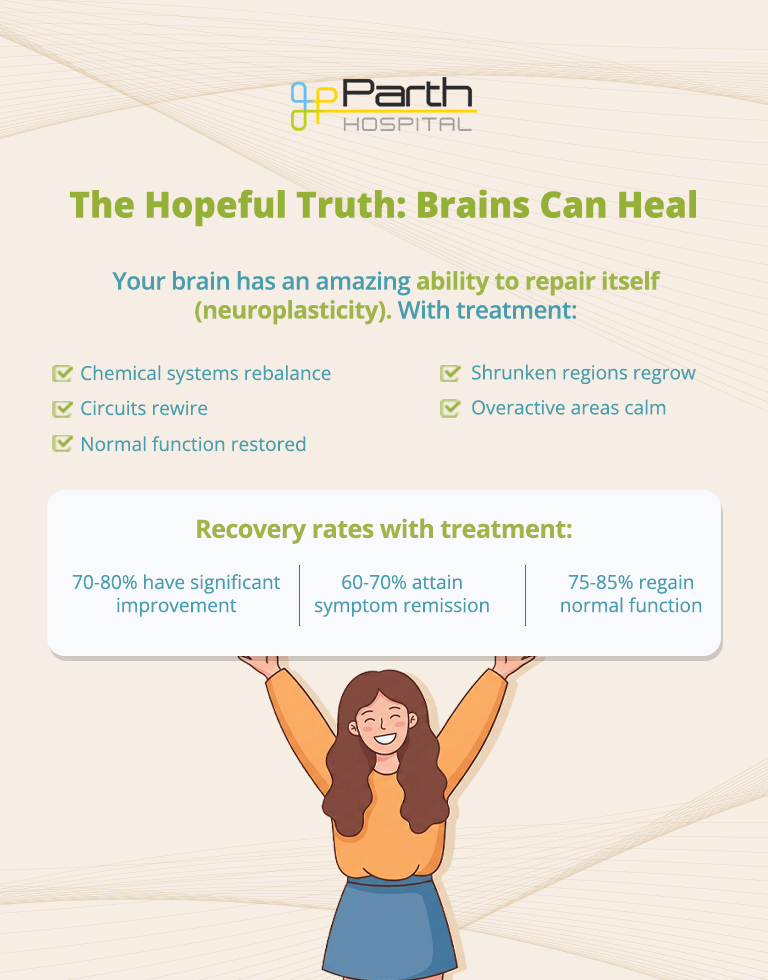
Your brain has an amazing ability to repair itself (neuroplasticity). With treatment:
- Chemical systems rebalance
- Circuits rewire
- Shrunken regions regrow
- Overactive areas calm
- Normal function restored
Recovery rates with treatment:
- 70-80% have significant improvement
- 60-70% attain symptom remission
- 75-85% regain normal function
Advanced treatments like brain stimulation can directly target and repair malfunctioning circuits when traditional approaches aren’t enough. Explore rTMS for treatment-resistant depression → Learn about Deep TMS treatment → Discover tDCS brain stimulation therapy →
When to Seek Help
If you’ve had 5+ of these for 2+ weeks:
- Can’t decide, concentration lost
- Nothing fun, no energy
- Ongoing sadness OR emotional numbness
- Sleep issues (insomnia or sleeping too much)
- Changes in appetite/weight
- Drained even after rest
- Memory issues, cloudy thinking
- Physical pain without reason
- Thoughts of death/suicide (seek help immediately 🆘)
Recognizing early warning signs can prevent a full crisis and lead to faster recovery. Warning signs your mental health may be declining →
Message to Families
Your loved one isn’t being lazy or weak. They’re experiencing brain circuit malfunction—a medical condition requiring professional treatment, not willpower.
Helpful: “I understand this is medical. Let’s get help together.” Not helpful: “Just try harder to be happy.”Family support and understanding play a crucial role in recovery outcomes. Learning how to support someone with depression effectively can make a significant difference.How family support affects mental health recovery →Sometimes people with severe depression may also experience distorted thinking or even hallucinations, which are also symptoms of brain circuit dysfunction.Understanding hallucinations in mental illness →
Bottom Line
Depression is a medical illness that impacts measurable brain circuits. It’s treatable, frequently reversible, and not a character defect. Your brain can recover. Recovery is likely with good treatment.
🏥 Parth Hospital Ahmedabad
Comprehensive Depression Treatment Center
📍 Address: 3rd Floor Sigma Excellence, Near Management Enclave, Opposite Falguni Gruh Udyog, Vastrapur, Ahmedabad, 380015
📞 Contact: (+91) 972 420 1332 (+91) 987 972 5516
📧 Email: info@parthhospital.com
🕐 Consultation Hours: Monday – Saturday | Morning: 9:00 AM – 1:00 PM | Evening: 4:00 PM – 7:00 PM
🌐 Website: parthhospital
📞 Get expert consultation from Parth Hospital Ahmedabad for thorough neurological assessment of depression.
📋 MEDICAL DISCLAIMER This content is for educational purposes only and does not constitute medical advice. Depression is a serious medical condition that requires professional diagnosis and treatment. The information provided here is meant to increase understanding and reduce stigma, not to replace consultation with qualified healthcare providers. Always seek professional medical advice for diagnosis and treatment of depression or any mental health condition.