



The Family’s Journey: From Confused to Confident
When Priya was diagnosed with Bipolar II in her first year of engineering college in Pune, her parents were lost.
“We didn’t know how to respond, what to say, whether to push her or leave her alone,” her mother admits. “We did lots of things wrong before finding the right path.”
Two years later: Priya graduated, now works as a counselor, and her family has become experts in bipolar management.
This is their story—and it can be yours, too.
Family Education: The Three Phases
Phase 1: Understanding (Weeks 1-4)
- Bipolar is physical brain illness, not bad parenting
- Episodes are temporary but need active care
- Medication is mandatory (like insulin for diabetes)
- Full recovery is achievable
Phase 2: Awareness (Weeks 5-8)
- Early warning signs specific to YOUR loved one
- Difference between personality and illness symptoms
- When to seek help vs. when to support at home
- How stress, sleep, seasons influence cycles
Phase 3: Action (Weeks 9-12)
- Crisis intervention skills
- Medication compliance strategies
- Lifestyle changes that work
- Build sustainable support network
Communication Strategies by Mood State
When Depressed:
| DO Say ✅ | DON’T Say ❌ |
|---|---|
| “I’m here for you, no judgment” | “Just think positive thoughts” |
| “This depression will pass with treatment” | “Snap out of it, everyone gets sad” |
| “What can I do to help right now?” | “You’re being dramatic and lazy” |
During Mania/Hypomania:
| DO Say ✅ | DON’T Say ❌ |
|---|---|
| “Let’s sit down and think about this calmly” | “You’re behaving totally crazy” |
| “I’m worried, can we speak to the doctor?” | “You need to calm down immediately” |
| “This could be part of your cycle” | “You’re messing everything up again” |
The Medication Challenge: Why People Stop
Most common reasons:
- Feeling “cured” – “I’m okay now, don’t need pills”
- Missing hypomania – “I enjoyed the energy and creativity”
- Side effects – “Weight gain, drowsiness feel worse”
- Stigma – “Taking psychiatric meds means I’m weak”
- Forgetting – Routine disrupted during travel, festivals
Strategies for Long-Term Success
| Strategy | How to Do | Why It Works |
|---|---|---|
| Make it simple | Pill box, phone reminders, tie to chai/breakfast | Eliminates “forgot” reason |
| Make it meaningful | Track mood improvement in diary | Shows medication worth |
| Make it supported | Family gentle reminders, auto pharmacy refills | Accountability system |
| Make it habitual | Same time daily (like brushing teeth) | Becomes second nature |
Daily Routine: The Anchor
Priya’s successful college routine:
| Time | Activity | Why It Matters |
|---|---|---|
| 6:30 AM | Wake up, take meds, check mood | Consistency settles brain |
| 7:00 AM | 30-min walk or exercise | Natural mood regulation |
| 8:00 AM | Healthy breakfast | Fueling brain |
| 9:00 AM-5:00 PM | Structured classes, study (with breaks) | Structure prevents chaos |
| 6:00 PM | Social time with friends | Connection prevents isolation |
| 9:00 PM | Wind down routine | Prepares body for sleep |
| 10:00 PM | Lights out (non-negotiable) | Sleep = mood stability |
The non-negotiables:
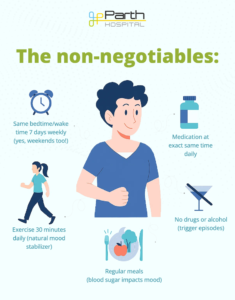
- Same bedtime/wake time 7 days weekly (yes, weekends too!)
- Medication at exact same time daily
- No drugs or alcohol (trigger episodes)
- Regular meals (blood sugar impacts mood)
- Exercise 30 minutes daily (natural mood stabilizer)
Family Monitoring Checklist
Daily quick check:
- How many hours slept last night?
- Eating regular meals today?
- Energy level on scale 1-10?
- Speaking speed normal or rapid?
- Plans realistic or grandiose?
Weekly deeper check:
- Any mood shifts this week?
- Taking medication as directed?
- New stressors at work/college/home?
- Any red flag behaviors?
When to Seek Immediate Help
Call doctor/go to hospital if:
🆘 Suicidal thoughts/plans
🆘 Severe mania (no sleep 3+ days, spending lakhs recklessly)
🆘 Psychosis (hearing voices, extreme paranoia)
🆘 Can’t care for basic needs (eating, hygiene)
🆘 Risk of harm to self or others
Financial Impact & Management
Before treatment (Kavya’s family):
- Manic spending: ₹1.5 lakhs credit card in 2 weeks
- Lost job: ₹30,000/month gone
- Hospitalization: ₹80,000 for 10 days
- Total crisis cost: ₹5+ lakhs in 6 months
After treatment & management:
- Medication monthly: ₹3,000-5,000
- Psychiatrist monthly: ₹1,500
- Therapy bimonthly: ₹2,000
- Annual total: ₹1 lakh vs. ₹5+ lakhs in crises
Financial protection measures:
- Restrict credit cards during manic episodes
- Joint bank account with two-signature approval
- Discuss big purchases with family before buying
- Automatic bill payments
Realistic Recovery Timeline
| Phase | Duration | What to Expect |
|---|---|---|
| Months 1-3 | Crisis stabilization | Finding right medication, creating safety |
| Months 4-6 | Skill building | Learning warning signs, coping techniques |
| Months 7-12 | Life reconstruction | Return to work/college, rebuild relationships |
| Year 2+ | Maintenance & growth | Managing stress effectively, helping others |
Questions Indian Families Always Ask
Q: “Will episodes get worse over time?” With treatment: Usually become less severe and less frequent Without treatment: Can become more frequent and intense Early intervention = better long-term outcome
Q: “Can my child marry and have kids?” Yes! Many people with bipolar have successful marriages and children. Need to discuss with doctor about pregnancy planning (some meds affect pregnancy). Partner education about condition is important.
Q: “Will this affect their career?” With treatment: Most people can have successful careers. Medical info is confidential—employers don’t need to know. Many professionals, artists, leaders have bipolar disorder.
Q: “What about our mental health as caregivers?” Family therapy and support groups are crucial. Individual counseling for parents/siblings. Self-care is essential, not selfish. You can’t help them if you’re depleted.
Rajesh’s Message (5 Years Post-Diagnosis)
“Bipolar is like diabetes—it’s a chronic condition requiring daily management. I take my mood stabilizer like a diabetic takes insulin.
The difference is: With right management, I don’t just survive—I thrive. Same engineering job 4 years, promoted, just got engaged.
To families beginning this journey: It gets better. Not easier necessarily, but better. The condition becomes manageable, predictable, something you work WITH rather than fight AGAINST.”
For Overwhelmed Families
Remember:
- You didn’t cause this condition
- You can’t cure it with willpower alone
- You CAN learn to manage it together
- Recovery is entirely possible
- You’re not alone
Most importantly: Bipolar disorder is something your loved one HAS, not something they ARE. With proper treatment, education, and management—they can have full, meaningful, successful lives.
📞 Call Parth Hospital Ahmedabad for comprehensive bipolar disorder treatment, family education, and long-term support.
Where every family becomes expert in their loved one’s care—and every patient finds stability.
⚠️ CRISIS RESOURCES: KIRAN Mental Health Helpline: 1800-599-0019 (24/7) Emergency: Go to nearest hospital if suicidal thoughts, severe mania, or psychosis
MEDICAL DISCLAIMER: This content is for educational purposes only. Bipolar disorder requires professional diagnosis and treatment. Information provided does not substitute for medical advice from qualified mental health professionals. Treatment plans should be individualized and supervised by licensed psychiatrists. Always consult healthcare providers for personalized medical guidance.